
Peak Performance in Talented People
Peak Performance in Talented People
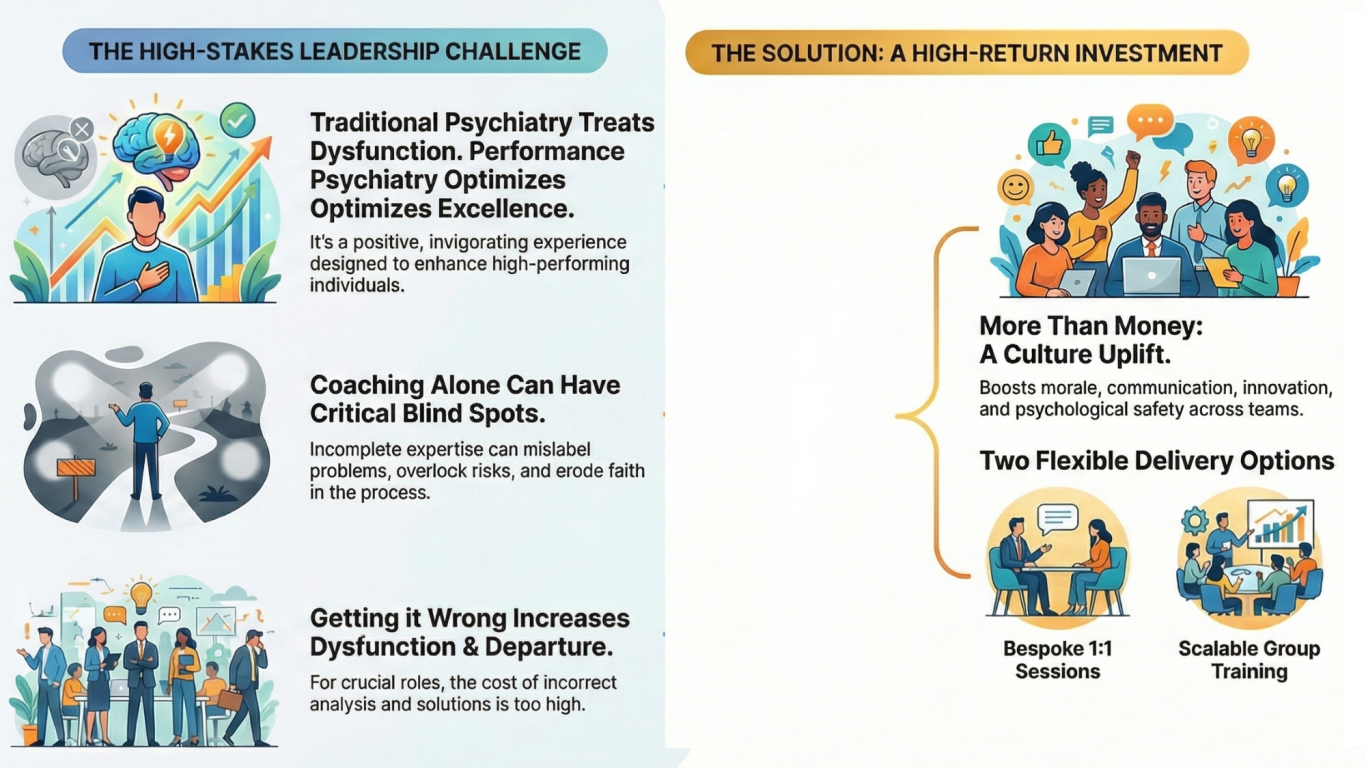
Traditional psychiatry treats dysfunction. Performance psychiatry optimises excellence.
For executives operating at the highest levels, the difference matters profoundly.
It's an invigorating and positive experience. It's an attractive umbrella, enhancing reputation of the people involved. It helps to know our track record of working with elite athletes and so on; it proves the pedigree. From high to low to the leftfield, we work with both high performers and those who are struggling, so there is no stigma or fear of judgment. Most people flourish with the right knowledge and techniques, reversing years of underperformance.
We don't report or resort to occupational assistance programs or traditional psychiatrists or counsellors, unless it's unavoidable, and even then only with the person's explicit approval. For information, we've not had to do this in 15 years of work at the highest level.
Nothing at all wrong with a good coach or consultant; the good ones are effective within their fields. However, many are not experienced or qualified to understand the mind fully. They're not aware of their blind spots, leading to mislabelling problems, over-ambitiousness in solutions, or overlooking risks and hazards altogether. As clients, your people lose faith in the process and the risks of despair, dysfunction, and departure increase.
C-Suite teams have too much at stake to risk on incomplete expertise. You want the right causes identified and the right solutions implemented. If your staff are critical and the work of your organisation is crucial, you know the cost of getting this wrong. From medical to psychological, social, cultural, therapeutic, we have the skills to get right to the heart of the issue. So if you want to get it right first time, come to us first.
In a short answer, yes and yes. Around 160 to 400% uplift depending on context (see below).
The session costs in line with premium management consultancy. Sessions are fewer and more impactful than with coaches or consultants, because sessions are planned and geared towards clear outcomes. In between sessions, the online tutorial prescriptions save hundreds of hours of time and cost, enabling clients to learn and perfect techniques which would otherwise be delivered in person In all cases, the investment is outweighed by much larger returns: clients enjoy approximately 160 to 400% uplift as measured in various pre-agreed parameters such as earnings, speed, retention, productivity, targets, new clientele, greater profitability, and avoidance of churn with the costs saved therein. Speak to our consultant to discuss with previous clients (with their consent) directly if you wish.
It's not just time and money though. Having a good intervention will show itself in the same way that investing in a top-quality toolkit benefits a workshop. People feel special and valued, and morale is uplifted. They get the job done better. They also notice improvements in general, such as reputation, a sense of increased mental bandwidth, safety in speaking truth, better camaraderie and communication, and an atmosphere that invites and profits from innovation rather than silencing it.
Every intervention assessment involves a calculation of this return: ethically, we keep to medical levels of ethics in our decisions: we will not get involved if we feel that it would not be worth your expense.
Broadly, two options exist. In practice, most smaller firms choose one or the other, whereas bigger firms adopt a mix of both. We try to work out your best option with you, given time, money and aims.
Choose to have 1:1 sessions for yourself or your crucial people, where you get to define bespoke aims. From optimising a new CEO's negotiation skills in a new merger, to helping a shy but talented performer to be more confident in driving through their strategy for corporate innovation.
Or go for the group training approach, using the benefits of scale across entire teams, with each member still having 1:1 bespoke support in between group sessions. People work on their individual strengths alongside unified group-level aims. This strategy is particularly useful for correcting real-world dynamic problems such as silos, power struggles, cultural conflicts, and communication issues.
Take the example of stress and anxiety. A common issue, but if the cause is not correctly identified, the treatment and consequences can be disastrous. Below, we set out just three out of many real causes of stress and anxiety.
Blood carries oxygen. A lack of oxygen causes the brain to struggle to think clearly. The commonest result of this is anxiety and stress. The cause may be blamed on any number of issues, and many hundreds of hours and thousands of dollars spent seeing psychologists, coaches or others who don't have the medical training to check for this simple cause.
Get it right and your person is in full health within a couple of weeks.
Narcissistic people create deep self doubt and anxiety in others, who become mystified with their anxiety because they can't see that someone else is causing it.
A careful discussion around the issue will reveal the cause to the performance psychiatrist, who can then recommend ways forward to manage the issue safely.
Narcissistic traits are tricky; they may even help some people to resist difficult circumstances. However, the toxic elements of narcissism do unfortunately thrive in corporate environments. Narcissists can get themselves promoted very rapidly, and the end result is always a disaster for everyone, sooner or later.
Some intelligent mildly autistic people can work to superhuman standards if their unique psychology combines with the often exacting, precise tasks they take an interest in.
But they often do so at personal cost of high anxiety and social isolation. Such a person may enjoy accolades and promotions at work but feel crippling anxiety especially in interpersonal and existential ways.
They are at high risk of departure without warning, The right diagnosis and strategies can transform their outlook dramatically. If not recognised, many such people live chronically lonely and privately dysfunctional lives.
Besides the 3 shown here, there are many other causes of stress and anxiety. Everybody has a different mind, a different body, a unique perception of their world, and there are too many different things at stake to just throw one solution at them.
This should throw generic 'stress management' courses into great doubt, yet they remain all too common as the attempted solution.
People deserve more careful understanding: just because you have a hammer, not everything becomes a nail. Only when you identify the issue can you find the right tool to fix it,
Jeremy was a fantastic software engineer. Without his talent the company would suffer. He was well liked; charming, always ready with wit and humour. He was recently made head of department, with a hefty pay rise, but for some reason he was deeply unhappy. So much so that he was about to leave. The CEO offered to get him a counsellor, but he rejected any offer of help. Nobody wants to be labelled as 'receiving therapy'. Jeremy was very private.
Unfortunately he didn't seem to handle being HOD very well. He just buried himself in work, leaving his team floundering and leaderless. The quality of his work suffered, but this only made him more possessive of it. Only he could fix it. He didn't want to teach anyone his systems. A friend who knew him divulged that he had started to drink more, to escape the stress and shame of it. The company was becoming vulnerable and beholden to his quirks. They called us to help.
Jeremy was fine to see us because we were there to help improve performance in the C-suite, seeing other talented people in the company too. Once he was assured that we were not going to label him as mentally unsound or refer him for the dreaded 'occupational assistance', he opened up. A few things came to light in his story. His perfectionism wasn't a surprise, but the doctor discovered and confirmed that there was also a tendency to possible ADHD, which he detected and confirmed with a specialised screening tool (called the ASRS). The problem was compounded by high social anxiety. He masked these things with the humour and charm he had learned as a kid getting through tough school years.
The treatment program consisted of several strands:
This case took around 9 months to see to completion. The improvements were immensely pleasing to witness, for Jim, his team, and even his family:
"Can you really help us?"
Some senior execs are sceptical of what can really be achieved, because their experience has taught them not to expect great change. The improvements seen in Jeremy's case might seem difficult to believe until you have seen them yourself.
This reason why performance psychiatry works is because the techniques and skills we bring are not usually seen in the field of business and high-functioning people. We bring scientific method and techniques from hard clinical practice to a field where these things are not commonly found. In our world, we're ethically bound to use only what is proven to work.

In the people you know and work with, aren't there some very capable people who:
The answer is that most hard-working people, especially those who achieve very highly, could do with better understanding themselves and addressing their potential avenues of strength and vulnerability. They deserve the wellbeing and rewards that come from bringing out their best abilities. Their workplaces, their loved ones, and their own personal lives also benefit.

Some people might just be surviving. They are doing an OK job despite significant pressures, They are at great risk of leaving or suddenly failing.
Talented but conscientious people handle their difficulties differently. Some are in denial about problems. Others may feel pressured or targeted, so they don't speak out. Others are simply embarrassed to admit they are struggling. They resist or skilfully evade help, even if it's offered.
The truth is people can perform much better, but they don't need therapy: they need to refine and enhance their skills, to bring out their best. This is also a core part of what we do.
We need your consent to load the translations
We use a third-party service to translate the website content that may collect data about your activity. Please review the details in the privacy policy and accept the service to view the translations.